
EcoTrace
High-Precision Energy and Emissions Instrumentation
v1.6.0 — Multi-GPU Continuous Tracking & Telemetry Resilience. Multi-GPU power aggregation, DDR3 RAM hardware detection, persistent offline disk retry queue for CloudExporter, and strict static type safety overhaul.
EcoTrace is a lightweight library for granular carbon footprint measurement of Python applications. No configuration files, no background services—just real-time hardware-level transparency.
Real-time monitoring | 50+ Global Zones | AI-powered insights | Zero-configuration



[!TIP] 🌐 Live Web Observatory: Stream and monitor your application carbon footprint in real-time on our hosted web platform at ecotracelibrary.com.
[!TIP] VS Code Extension: Monitor application carbon footprint in real-time during development. Download here.
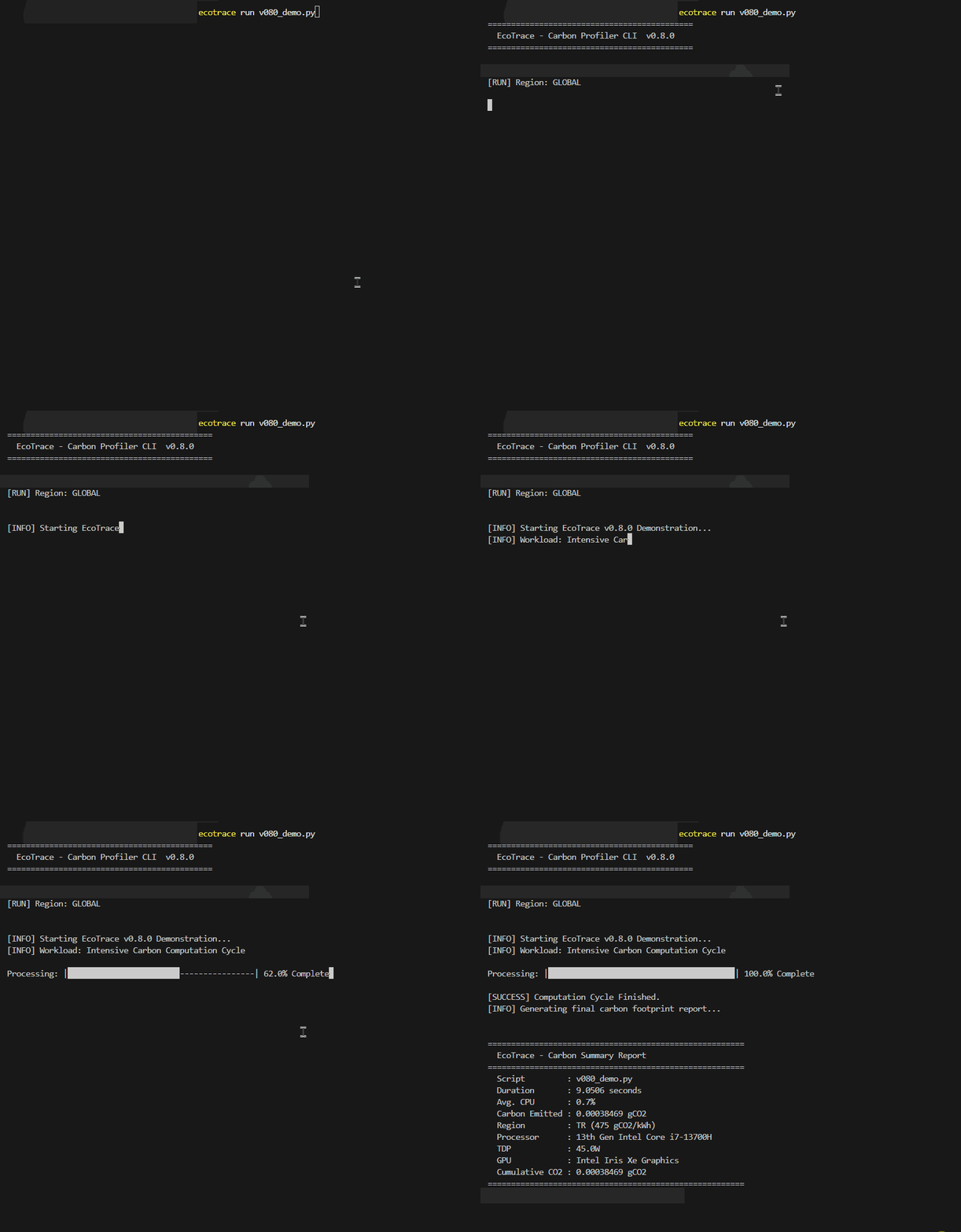
Function-level carbon measurement with real-time monitoring
Core Features in v1.6.0
Latest Release. v1.6.0 introduces automated multi-GPU continuous power tracking, DDR3 RAM hardware detection, a persistent offline disk retry queue for cloud telemetry, and a comprehensive type safety overhaul.
- Automated Multi-GPU Tracking & Aggregation (
ecotrace.gpu) — Automatically discovers all available NVIDIA GPUs via NVML (get_all_gpu_info) and aggregates instantaneous power draw at 50ms intervals across active accelerators (get_all_gpu_power_w). - Comprehensive Multi-Device Telemetry — Startup logs, session summaries, and exported JSON/CSV artifacts now report full GPU array metadata (total GPU count, device models, and combined TDP limit).
- Offline Disk Retry Queue (
CloudExporter) — Telemetry payloads are safely persisted to an isolated local disk queue (~/.ecotrace/retry_queue) during network outages or backend 5xx errors, automatically flushing in chronological FIFO order (up to 50 entries) upon reconnection. - DDR3 RAM Speed Detection (
ecotrace.ram) — Evaluates memory clock frequencies (800–2133 MHz) via Linuxdmidecodeand Windows WMI, applying calibrated DDR3 power factors (0.500 W/GB) for accurate carbon accounting on legacy enterprise hardware. - Strict Static Type Safety & Diagnostics Overhaul — Complete overhaul eliminating
# type: ignoreworkarounds acrosscore.py,gpu.py, and exporters, achieving clean IDE diagnostics under Pyright/Pylance and hardened exception handling. - Unified Multi-Device Architecture — Deprecates single-device
gpu_indextargeting in favor of unified multi-accelerator tracking, emitting a backward-compatibleDeprecationWarningifgpu_index > 0is passed.
Quick Install
pip install ecotrace
Optional extras:
pip install ecotrace[gpu]   # NVIDIA GPU support
pip install ecotrace[ai]    # Gemini AI insights
pip install ecotrace[all]   # Everything
Quick Start
Option 1: Zero-Code Profiling (CLI + Cloud Sync)
Authenticate your terminal once, then profile any script without changing source code:
# 1. Login with your ingestion key from https://ecotracelibrary.com
ecotrace login --key eco_usr_abc123...

# 2. Run your script — metrics automatically stream to your web dashboard!
ecotrace run my_script.py
Option 2: Programmatic Tracking & Cloud Dashboard
Decorate functions for granular instrumentation and stream metrics to your web account:
from ecotrace import EcoTrace

# Connects directly to your hosted account at https://ecotracelibrary.com
eco = EcoTrace(api_key="eco_usr_abc123...", region_code="US")

@eco.track
def my_function():
    # Your heavy processing here
    pass

my_function()

# Export audit-ready reports or check cumulative totals
eco.generate_pdf_report("carbon_audit.pdf")
print(f"Total Carbon Emitted: {eco.total_carbon} gCO2")
Option 3: Carbon Budget Mode
Set a limit and let EcoTrace enforce it:
eco = EcoTrace(
    region_code="TR",
    carbon_limit=5.0,                   # 5 gCO2 budget
    on_budget_exceeded=lambda t, l: print(f"Budget exceeded: {t:.4f}/{l:.4f} gCO2")
)

@eco.track
def training_pipeline():
    ...

training_pipeline()
print(f"Remaining budget: {eco.remaining_budget} gCO2")
Expected Output
When initialized, EcoTrace performs automated hardware detection:
[EcoTrace] INFO: [INFO] EcoTrace instrumentation session initialized (STATIC).
[EcoTrace] INFO: -----------------------------------------------------
[EcoTrace] INFO: Region        : TR (475 gCO2/kWh)
[EcoTrace] INFO: Hardware Logic: 13th Gen Intel Core i7-13700H
[EcoTrace] INFO: Specifications: 20 Cores | 45.0W TDP
[EcoTrace] INFO: Energy Sensor : Boavizta Advanced Estimation
[EcoTrace] INFO: Memory Config : 15.6 GB DDR4
[EcoTrace] INFO: GPU Accelerator: Intel Iris Xe Graphics (15.0W TDP)
[EcoTrace] INFO: -----------------------------------------------------
At process exit, a session summary is printed automatically:
=======================================================
  EcoTrace — Session Summary
=======================================================
  Duration       : 12.34s
  Functions      : 5 tracked
  Total Carbon   : 0.00312000 gCO2
  Region         : TR (475 gCO2/kWh)
  Budget         : 0.003120 / 5.000000 gCO2 (0.1%) [OK]
  Equivalent     : 0.4 min of LED bulb (10W)
=======================================================
CI/CD Integration
Official GitHub Action
Enforce carbon budgets in your pipeline with our official GitHub Action. Add this to your .github/workflows/ci.yml:
- name: EcoTrace Carbon Gate
  uses: Zwony/ecotrace@v1.6.0
  with:
    budget: '10.0'
    region: 'US'
Manual CLI Integration
You can also run the gate manually:
ecotrace gate --budget 10.0
If total emissions exceed the budget, the gate fails with exit code 1 — preventing carbon-heavy code from being merged.
Why EcoTrace?
| Feature | EcoTrace v1.6 | CodeCarbon | CarbonTracker |
|---|---|---|---|
| Sampling Interval | 50ms | 15s | Per Epoch |
| Isolation | Process-scoped | System-wide | System-wide |
| Cloud Dashboard Sync | Native | No | No |
| Multi-GPU Tracking | Continuous (Aggregated) | Single GPU | Per Epoch |
| CPU Dataset | 6,980+ CPUs | Limited | Limited |
| Budget Enforcement | Built-in | No | No |
| CI/CD Gate | Built-in | No | No |
| Idle Noise Subtraction | Automatic | No | No |
| Async Support | Native | Limited | No |
- Deep Transparency: Derived from 6,980+ verified manufacturer TDP specifications rather than category averages.
- Fail-Safe Architecture: Guaranteed application continuity even if hardware drivers or API keys are missing.
- Actionable AI: Integrates with Google Gemini to provide specific code optimization advice (optional).
Documentation
- Official Website — Live carbon dashboard and web management platform.
- Architecture and Science — How the energy model and process isolation work.
- Advanced Usage — GPU tracking, AI insights, benchmarks, and comparison tables.
- Support and Reference — Troubleshooting, region codes, and hardware compatibility.
Contributing
We welcome contributions! Please see our CONTRIBUTING.MD for guidelines on reporting bugs, suggesting features, or contributing hardware data.
Community

Author and License
Emre Ozkal — GitHub · ecotraceteam@gmail.com
MIT License — Use it however you like.
Developed for sustainable software development practices.